The Outlier Shaft: A Measured Protocol for Retiring a Suspect Arrow
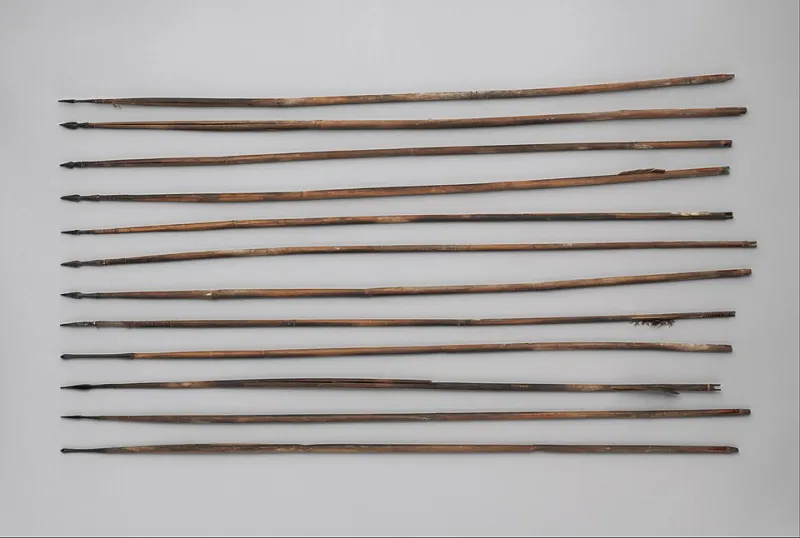
Photo: Unknown, CC0, via Wikimedia Commons
Every indoor archer eventually meets the arrow that will not behave. It is rarely the one that misses by a metre; more often it is the shaft that sits half a ring wide, or low, or left, just often enough to erode confidence. The temptation is to label it bad and remove it. That is sometimes the right decision, but it should not rest on a feeling. The protocol below is a practical way to find a genuine outlier, confirm it in the club hall, and retire it on evidence rather than superstition.
Start with a written record
Before any bench test, establish what the arrow has actually done. Number the set clearly, using small labels or a written code that will not rub off in a quiver. Record the date, distance, target face, end number, and where each shaft lands. A simple notebook or phone note is enough. The aim is not to prove a favourite theory; it is to see whether the same number appears outside the group across several ends. One loose shot is not a case. A pattern is.
At the same time, inspect the arrow for obvious damage: cracks in the carbon, dents in aluminium, a lifted vane, a loose insert, or a nock that fits poorly. Any structural fault takes the shaft out of service immediately. Safety comes before diagnosis.
Bench checks: straightness, nocks and fletching
Spin testing is the first useful mechanical check. An arrow spinner is ideal, but two smooth V-blocks or a purpose-made roller will do. Support the shaft at both ends, spin it, and watch the point and nock for runout. A wobble at the nock can be caused by the nock itself rather than the shaft, so remove the nock and repeat the test. If the shaft runs true without the nock, replace the nock and test again. Check the insert or point for alignment; a bent point on an aluminium arrow is easy to see on a flat surface. Carbon shafts should be inspected for cracks, whitening, or impact marks. Any suspect carbon shaft should be retired from shooting, not merely moved to the practice set.
Fletching deserves equal attention. A vane that has lifted at the leading edge, a glue line that has failed, or a fletching that contacts the rest can produce a repeatable outlier. Refletch one arrow, using the same vane and orientation as the rest of the set, and shoot it again. If the arrow returns to the group, the fault was fletching, not the shaft. Nock fit is also worth checking: a nock that is too tight or too loose changes the launch. Replace suspect nocks as a matter of course and keep a small stock of the correct size.
Spine and weight: useful context, not a verdict
Spine and weight markings provide context, not a verdict. Check that the suspect shaft carries the same spine designation and batch marking as the rest of the set. If a scale is available, weigh the arrow complete. Small differences are normal; a shaft that is markedly outside the batch is worth flagging, but it should still be confirmed in the hall. Indoor archery at 18m is less forgiving of a poor release than of a few grains of weight, so do not use a scale reading alone to condemn an arrow. The same applies to spine: a printed marking is a starting point, not proof of performance.
The club-hall trial
The club hall is the only place where the evidence matters. Set up at the usual indoor distance, whether that is a Portsmouth round or a WA 18m practice. Use the numbered set and shoot a controlled trial: six arrows per end, eight to twelve ends, same target face, no sight adjustments during the trial. Ask a clubmate to record the plot so the archer is not judging and shooting at the same time. Rotate the shooting order of the arrows between ends to avoid giving one shaft a consistent position in the sequence. Compare each arrow with the group centre rather than with the single best arrow. A suspect shaft that sits outside the main group in three or four ends, across two separate sessions, is a genuine candidate for retirement. A single bad end is not.
A decision checklist
Use the following checklist before removing a shaft from the competition set. Retire immediately if there is structural damage, a cracked nock, a bent point that cannot be corrected, or any doubt about carbon integrity. Move the arrow to a numbered practice set if it shows repeated outlier behaviour after nock and fletching faults have been corrected, or if its spine or weight is clearly outside the batch and the hall trial confirms it. Keep it in the competition set if no mechanical fault is found and the outlier has not repeated; mark it for review and test again in a fortnight. Do not retire an arrow solely because it was the last one shot, because it has a different fletching colour, or because a bad end coincided with a change in the weather. Evidence should survive a second look.
Retiring without waste
Retirement does not always mean destruction. A shaft with no structural fault can be marked with a band of tape and kept for routine practice, but it should not return to the competition set without a fresh trial. A damaged carbon shaft should be removed from service altogether and disposed of responsibly; it should not be used for blank bale or any other shooting. Keep the competition set separate and labelled. The point of retirement is to reduce variables, not to create a drawer of mystery arrows.
A numbered winter practice set
Winter is the ideal time to build a small numbered practice set: six to twelve shafts of the same spine and approximate weight, marked clearly and logged. Use it for form work, blank bale, and the less glamorous repetitions that indoor training rewards. The competition set stays distinct. When a competition arrow becomes suspect, it can be tested against the practice set and, if confirmed, moved across without disrupting the main set. This is a modest habit, but it turns arrow management from a superstition into a routine. In a sport decided by small margins, a shaft that is genuinely off is worth finding; a shaft that is merely suspected is worth testing. The difference is evidence.