The Quiet Interval: Turning Indoor Archery's Between-Ends Downtime into a Competitive Habit
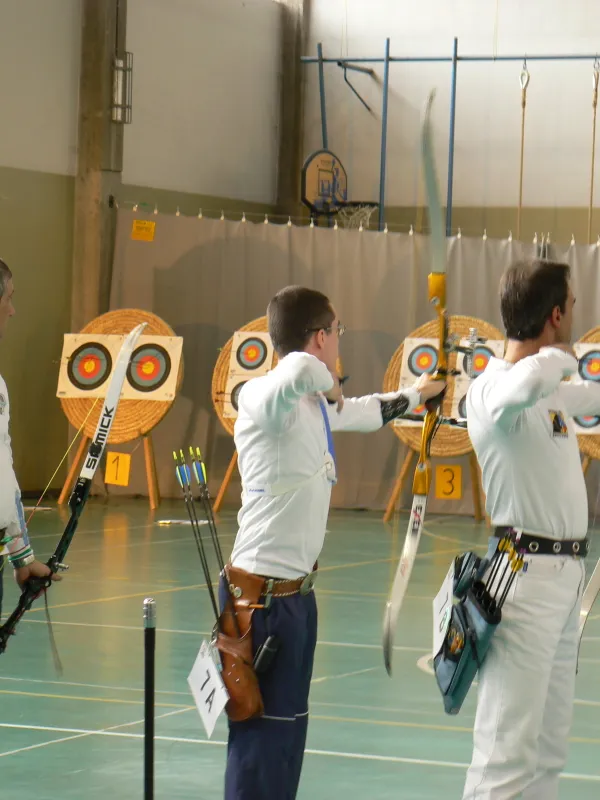
Photo: Nicolò Nepote at it.wikipedia, CC BY-SA 3.0, via Wikimedia Commons
Indoor archery competitions in the UK rarely reward the archer who shoots the most spectacular single end. They reward the archer who returns to the line, end after end, with the same reliable process. Yet most practice time is spent on the shot itself, while the interval between ends is left to chance. That interval is not dead time. It is a short, repeating window in which warmth, attention, administration and physical tone can either be maintained or allowed to drift.
Why the interval deserves practice
A typical indoor round asks for sustained concentration across many ends. The shooting line demands precision; the space between ends demands restraint. Archers often use that space reactively: adjusting equipment, discussing scores, chasing a feeling from the previous end or simply sitting down. None of these actions is inherently wrong, but without a planned routine they can introduce variability. A rushed scorecard, a cooling shoulder or an unresolved technical thought can follow the archer back to the line.
The purpose of a between-ends routine is not to add complexity. It is to reduce the number of decisions made under mild pressure. The routine should be short enough to fit the available time, robust enough to survive a noisy venue and simple enough to be repeated when concentration is naturally lower.
A four-part routine for the indoor season
The following framework is deliberately modest. It can be adapted to the interval length at a given competition and rehearsed at club nights during the 2026 indoor season.
1. Maintain warmth rather than chase it
Indoor venues vary considerably. Sports halls can be warm, but waiting areas, corridors and equipment tents are often cooler. Rather than waiting until the shoulders feel stiff, build a small amount of movement into every interval. A short walk to the scoreboard, a few controlled shoulder rolls and gentle arm swings may be sufficient. The aim is continuity, not a second warm-up.
Archers who sit for long periods and then produce a full stretching routine immediately before shooting may create more variability than they remove. A consistent, low-level pattern of movement is easier to repeat and less likely to interfere with the next end.
2. Use one focus cue, not a technical audit
The interval is a poor time for a full technical review. A single cue, chosen before the round begins, is more useful. It might relate to the position of the bow hand, the direction of the draw elbow or the rhythm of the release. The cue should be observable and narrow.
After each end, the archer can note whether the cue was present, without turning the interval into a debate about the last arrow. This preserves attention for the next end and prevents a single poor shot from becoming the theme of the round.
3. Treat the scorecard as part of the routine
Scorecard discipline is frequently overlooked in practice. In competition, scores must be recorded accurately, checked by the other archer on the target and signed at the appropriate time. Rushing this process creates avoidable anxiety and can delay the next end.
A simple sequence helps: record the scores immediately, read them back if required, place the pen and card in a fixed position, then return attention to the physical routine. Archers should practise this sequence at club nights with the same card layout and the same pen placement they intend to use in competition. Familiarity reduces the mental cost of administration.
4. Reset the body without overcorrecting
A short physical reset can bridge the gap between one end and the next. This might include releasing tension in the bow hand, settling the shoulders and taking two or three calm breaths. The intention is to return to a neutral physical state, not to manufacture a perfect feeling.
Archers should avoid making equipment adjustments during this reset unless a genuine fault has been identified. Small changes made in reaction to a single end are difficult to evaluate and often add uncertainty.
Rehearsing the routine at club nights
A routine that has only been considered in theory is unlikely to hold under competition conditions. Club nights provide a useful rehearsal environment because they contain many of the same distractions: conversation, waiting, scoring and changes in pace.
One practical approach is to set aside a portion of a practice session for full-round simulation. The archer shoots an end, completes the between-ends routine exactly as intended, records the score and returns to the line. The focus is on the transition rather than the group size. Even two or three simulated intervals can reveal whether the routine is realistic.
It is also worth rehearsing the routine when conditions are less than ideal. A crowded shooting line, a delayed start or a nearby conversation should not be treated as reasons to abandon the process. The routine should be stable enough to tolerate minor disruption.
Common pitfalls to avoid
Several habits undermine otherwise sensible between-ends plans. The first is overloading the interval with technical analysis. The second is using the time to seek reassurance from other archers about equipment or scores. The third is allowing the interval to become either completely passive or unnecessarily busy.
The routine should also be reviewed periodically. A pattern that works in a quiet practice hall may need simplifying in a larger competition venue. The archer should be willing to adjust the timing and content of the routine while keeping its purpose intact: to return to the line prepared, warm and attentive.
A small habit with a cumulative effect
Indoor competition rewards consistency over drama. The between-ends interval is repeated many times in a single round, which makes it an efficient place to build that consistency. A short routine covering warmth, one focus cue, scorecard discipline and a physical reset will not guarantee a personal best. It will, however, reduce the number of avoidable variables that separate one end from the next.
For UK archers preparing for indoor competitions in 2026, the quiet interval is worth practising with the same care as the shot itself. It is one of the few parts of the round that can be fully controlled, and it is available at every competition, on every target, without any equipment change at all.