The Hall Is Not the Field: Auditing Your Indoor Sight Picture
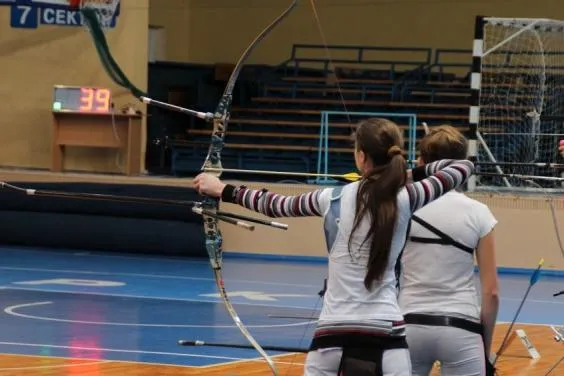
Photo: Харківська обласна державна адміністрація, CC BY 4.0, via Wikimedia Commons
Indoor archery is often described as a simpler discipline: a fixed distance, a controlled environment and a level floor. That simplicity is useful for scoring, but it can disguise a practical problem. The hall asks your eyes to work in conditions that are quite different from the outdoor field, and a sight picture that felt dependable in summer may become vague once the winter programme begins.
The issue is not that indoor ranges are poorly lit. It is that they are lit differently. Fluorescent tubes, LED panels, sports-hall glazing and nearby fire exits create a patchwork of brightness and colour. The backstop sits close behind the target, often a flat wall or curtain, so the eye has less distant information to use. Shadows from the hall structure or from other archers can fall across the target face. None of these factors changes the arrow's flight, but each can change what the archer perceives at full draw.
A reliable indoor sight picture therefore needs to be audited, not assumed. The aim is not to find a perfect visual condition; it is to establish a repeatable reference that survives the conditions you actually shoot in.
Why the indoor picture feels different
Outdoors, the eye has plenty of information to work with. The target stands against a distant background, the light is usually broad and the horizon gives the visual system a natural reference. Indoors, much of that information is removed. The target face may be the brightest object in view, the backstop may be only a metre or two behind it, and the hall ceiling can fill the upper part of the visual field with flat, even illumination.
This matters because aiming is not simply a matter of placing a pin on a gold. The archer is managing at least three visual relationships at once: the clarity of the sight pin, the apparent depth of the target face, and the alignment of the string relative to the bow and the target. In a hall, each of these can shift subtly from one venue to another. A pin that appears crisp under one set of lights may seem soft under another. A target face that looks flat against a close backstop may encourage the eye to focus too near. A string that is easy to see against a dark curtain may disappear against a pale wall.
These are not faults in technique. They are adaptations to the visual environment, and they become a problem only when the archer is not aware of them.
The three variables to audit
A useful indoor audit concentrates on three variables: illumination, contrast and alignment.
Illumination concerns both brightness and colour. Many sports halls use lighting with a cooler colour temperature than outdoor daylight, and some older fittings produce a slight flicker that is not always obvious. The practical question is whether the target face and the sight pin are equally comfortable to look at. If the face is much brighter than the pin, the eye may struggle to hold a stable focus. If the hall is dim around the target but bright above it, the archer may be tempted to lift attention away from the gold.
Contrast concerns the relationship between the target, the backstop and the string. A gold face on a pale wall presents a different visual task from a gold face on a dark curtain. The same is true of the string. A dark string against a dark backstop can be difficult to place consistently, while a pale string against a bright wall may create a distracting outline. The archer does not need to change equipment for every hall, but they should know what their reference looks like in the venues they use most often.
Alignment concerns the relationship between the string, the bow and the target. Indoors, the short distance and the flat background can make small misalignments less obvious. A string picture that is clearly wrong outdoors may look almost acceptable in a hall. This is why indoor practice should include a deliberate check of string alignment, not merely a check of where the pin is pointing.
A ten-minute hall audit
The audit can be carried out at the start of a practice session, before the first scoring end. It should be done on the shooting line, with bow and arrows handled according to club and range rules. Where a drill calls for a sight picture without shooting, use an unloaded bow or a supervised setup.
Begin by standing on the line and looking at the target without the bow. Note the brightest part of the hall, the darkest part and the colour of the light on the target face. Then raise the bow and build your normal sight picture. Ask three questions. First, is the pin crisp without effort, or are you forcing focus? Second, does the target face appear to sit at a comfortable distance, or does the close backstop make it feel flat? Third, can you see the string alignment clearly against the background?
Next, check the shadow. Move your stance slightly, if range rules allow, and see whether the string shadow or bow shadow falls across the target face. A shadow that moves as you move is a useful warning that your visual reference is being influenced by the hall rather than by your setup.
Finally, repeat the check at the end of the session. Fatigue changes the eyes as much as it changes the shoulders. If the sight picture is noticeably harder to hold after fifty arrows, that is useful information for competition preparation.
Drills for a repeatable reference
One simple drill is the pin-hold check. With an unloaded bow, raise and settle into your normal anchor, then hold your attention on the sight pin for five slow breaths. Do not aim at the gold; simply observe whether the pin remains clear and whether your eye is drawn to the bright target face. Repeat three times. The purpose is to identify the point at which focus begins to drift.
A second drill is the string-alignment check. Set up at the line with a clear view of the target and the backstop. Build your sight picture and alternate your attention between the pin and the string, without changing your anchor. The aim is to confirm that the string alignment you use outdoors remains visible and consistent indoors. If it does not, adjust your visual reference rather than your anchor.
A third drill is the contrast walk. If the hall allows it, compare the sight picture from two or three adjacent shooting positions. Note how the background changes and whether the target face appears brighter or flatter. This is particularly useful in shared sports halls, where one end of the range may be lit quite differently from the other.
Recording what you find
A short written note is more useful than a vague memory. Record the venue, the lighting conditions, the colour of the backstop and any shadow patterns that affected the target face. Note whether the pin was clear, whether the string was easy to see and whether the target appeared flat or distant. Over a winter season, these notes become a practical guide to the halls you shoot in most often.
The record should also include what you did about any problem. If you changed your visual focus, adjusted your stance or simply accepted a less crisp pin, write it down. The value lies in making the adaptation deliberate rather than accidental.
When to adjust the setup
Indoor conditions rarely justify major equipment changes on their own. A softer pin or a different string colour may help in one hall, but it can create new problems elsewhere. The first response should be to audit the sight picture and make small, reversible adjustments to the archer's visual reference. Only after that should equipment be considered, and then only with evidence from more than one session.
The indoor season rewards consistency. A sight picture that is understood, checked and recorded is easier to trust when the pressure of a county league match arrives. The hall is not the field, and it does not need to be. It simply needs to be read clearly.