The Observer's Brief: Turning a Club Night Pairing into Deliberate Practice

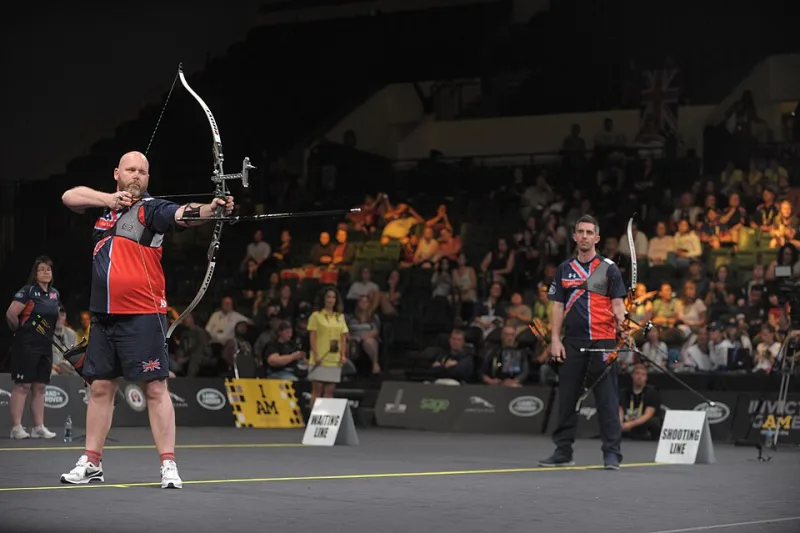
Photo: two archers indoor archery club night observer behind shooting line target faces, via img.freepik.com
The club night problem
Most UK club nights are built for volume, not for attention. Two hours in a leisure centre or village hall, a rota of bosses, perhaps thirty archers on the line and a coach with a queue at the table. The shooting is regular; the practice is often incidental. Archers leave having loosed a respectable number of arrows and having learned very little about any of them.
That is not a criticism of clubs, which run on volunteer time and goodwill. It is simply the arithmetic of the format. If a coach can give each archer five minutes in an evening, the archer who wants more must find it elsewhere on the line — and the most reliable source is another archer.
A practice partnership is not a chat with a friend between ends. It is a small, disciplined arrangement with agreed roles, a stated purpose and a fixed feedback loop. Done well, it costs nothing, fits inside the existing club night, and produces the kind of specific information a coach would otherwise need an hour to gather.
Before the first end: ten minutes of terms
Arrive early enough to agree the terms before the line fills. Four questions are enough.
- What is the session for? One target only. The release, the settle before the clicker, the follow-through, holding a shot under time pressure. Two aims means neither gets watched.
- How long do we run before swapping? Three ends each is a sensible default indoors; it is long enough for a pattern to emerge and short enough that the observer does not lose concentration.
- What gets written down? A single sheet, split into ends, with columns for the call and the outcome. Nothing more elaborate.
- What stays off the table? Scores, kit, and the state of the nation. Agreement up front prevents the drift back into social shooting.
Write the purpose at the top of the sheet. It is remarkable how quickly a pair forgets what they agreed once the first dozen arrows are in the target.
What the observer actually watches
The temptation is to watch everything, which in practice means watching nothing. Narrow the brief to three windows.
The start of the routine. Where does the shot begin? Feet, stance, the first movement of the draw. An observer behind the archer sees the balance shift and the set-up far more clearly than the archer does.
The draw and the hold. Is the draw elbow travelling on the arrow line, or swinging out and back in? Does the anchor arrive before the clicker, or does the clicker arrive first and the anchor follow? Standing directly behind, at a comfortable distance rather than leaning over the archer's shoulder, gives the clearest view of alignment.
The finish. What happens in the two seconds after the release? Does the bow arm hold its position or drop? Does the drawing hand travel backwards along the jaw, or open outwards? Does the archer stay in the shot or step away from it?
Keep the observation silent during the end. Commentary while an archer is shooting is a distraction, not a service, and it breaches the ordinary courtesies of the line. Watch, note, wait for the whistle.
The call-the-shot drill
Calling the shot is the cheapest and most underused practice tool available to a club archer. The shooter states the expected result before turning to the target — high-left, low-right, on the line but weak, clean. The observer records the call alongside the actual arrow.
Three things follow from this. First, the archer begins to build an internal model of the shot rather than reading the target and working backwards. Second, the pair accumulate evidence of bias — a genuine pattern of low-left calls that land low-left is a different problem from random error. Third, and most usefully, the drill exposes the shots where the archer felt nothing at all. Those are the arrows worth discussing.
Review calls at the end of each three-end block, not after every arrow. Patterns take a few ends to appear, and a single stray arrow is rarely instructive.
Feedback that changes the next end
A partner's feedback earns its place only if it alters what happens next. The formula that works is short: one observation, one cue, one question.
Observation: "In all six arrows your bow hand opened at the release."
Cue: "For the next end, keep the grip soft and let the follow-through carry the bow forward."
Question: "Does that match what you felt?"
The question matters. It hands the interpretation back to the shooter, and it surfaces the difference between what an archer believes they are doing and what is visible from behind. If the archer says the hand felt closed, that is useful information rather than a contradiction.
Keep the exchange to ninety seconds. Praise should be as specific as correction — "your anchor arrived before the clicker on five of six" is worth more than "good end".
A workable shape for the evening
Ten minutes to set up and agree terms. Three ends shooting while the partner observes. Swap. Three ends the other way. Then a short block in which both shoot with a single shared focus, no observation, applying whatever the first half revealed. Close with five minutes of notes: one line each, one thing to carry forward, a date for the next session.
That structure leaves room for the club's own business — the rota, the tea, the conversation — without letting the practice dissolve into it.
Common ways it goes wrong
The partnership usually fails in predictable ways. The pair begin scoring and stop observing. The observer offers six corrections instead of one. Someone coaches mid-end, or coaches the wrong thing because the last arrow went low. A stronger archer treats a less experienced partner as an audience rather than an equal. And frequently, both archers spend so long talking that neither shoots enough to gather evidence.
Any of these can be corrected by returning to the sheet: one purpose, one observation, one cue.
Where a partner ends and a coach begins
This is not a substitute for coaching and should never be presented as one. A partner sees what is visible and can describe it accurately; a coach diagnoses, prescribes and sees the season rather than the end. Where a club coach is present, share the sheet. A page of recorded calls and observations is a considerably better starting point for a coaching session than a recollection of how the evening felt.
For the archer with limited access to one-to-one time, though, a structured partnership is the difference between practising and merely shooting. It costs one conversation at the start of the evening and repays it by the end.